![]() |
| The Taste of Tulalip, oil on canvas, 24 x 30 inches |
Live Event Paintings
Sunday, November 15, 2015
Painting the Taste of Tulalip
Friday, November 9, 2012
McClelland- Miller Wedding, Fort Worth Zoo, Fort Worth, Texas
![]() |
| McClelland-Miller Wedding (detail; click to view full image) November 3, 2012 |
Wednesday, August 15, 2012
Billy and Ingrid at Melrose Market Studios
Thursday, August 9, 2012
A 60th Birthday Party at Newcastle Country Club
Thursday, May 3, 2012
Painting the Tacoma Heart Ball 2012, Hotel Murano
The Tacoma Heart Ball is the annual gala auction for the
Tacoma chapter of the American Heart Association. Friday, April 27, 2012 was
the third year I’ve painted this event. The venue this year was the über-stylish
Hotel Murano. Formerly the Sheraton Tacoma, a stark, mid century Modern high
rise, the Murano is now a veritable art museum. It’s namesake is the famed
glass blowing island in Venice, where centuries of tradition have refined the
glass art that lives on in the Pacific Northwest, in large part because of
Tacoma’s native son cum patron, Dale Chihuly. 
In this tall lobby, enormous glass canoes hang like chandeliers— an homage yet again, this time to the Salish tribes of Puget Sound. They appear distant in my painting only because they are. I set up my easel on the third story of a four story atrium, looking down the long hall toward the ballroom. We see the canoes lengthwise, so in the painting, alas, they look like hanging vases.
The hotel lobby bar is to the left on the main level. Unfortunately
hidden beneath the balcony from my view, the bar’s north wall is almost
entirely covered by a framed print, my favorite work of art in the building: a
full size Chuck Close (another Washington favorite son.) Monday, April 23, 2012
The Brooks Wedding, Hotel 1000, Seattle
A creamy,
conservative northwest palette was punctuated with brilliant spring colors, in
small bouquets. Similarly, the bride’s unassuming but oh-so-beautiful dress was
accented with carmine red pumps, and her bridesmaids’ shoes were orange.
Noticed perhaps by only the wedding party, there was also a covert theme of
black and white stripes, on the groom’s socks and the bride’s heels. Having had
this pointed out to me, I made sure they were in the painting. Monday, November 28, 2011
Macias-Lawson Wedding, Arctic Club Hotel, Seattle, November 26, 2011

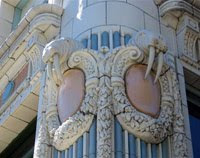
The Arctic Club Hotel is one of the greatest pieces of architecture in Seattle. Built in 1917, it is distinguished by two-dozen terra cotta walrus heads lining the Cherry Street and Third Avenue facades. After the Nisqually earthquake ten years ago, when the building was languishing as city offices, some of these walruses had their tusks held on with duct tape. But in recent years the building has been acquired and beautifully restored to its historic splendor by a company of Mr. William Lawson, whose son was married there on Saturday.
The building is mixture of architectural styles, but the Dome Room evokes Paris in the Belle Époque. I have painted in the room before, and I hope to again— many times. In fact, I think it would be my dream art studio. So it was really a privilege to paint the room for its new owners.

This painting was also an opportunity for me to do something I’ve never done before: a vertical wedding painting. The size and format were actually dictated by the wall on which the painting will eventually hang, but it works compositionally because of the Dome Room’s magnificent stained glass ceiling, which occupies the top half of the painting.
At most weddings and events, I paint on a French easel, which is a portable travel set designed in the days of the Impressionists to carry enough paints in the box for a plein aire outing. I use this for paintings up to 30 inches high, though it gets a little rickety with torque on paintings as wide as 40 inches. For the Macias-Lawson wedding, the canvas was 48 wide and 60 high— the second largest I’ve done for an event, and by far the tallest. I rented a van to move a big easel from the studio, even though the venue was just six blocks away! (Its also unadvisable to walk through the neighborhood carrying a big wet oil painting in the rain, after midnight.) The easel was designed for paintings up to 59 inches high, and needed a minor modification for this job. But it has a great sliding carriage, which allowed me to set the painting low at first, when I painted that grand ceiling before the wedding, and simply slide the whole thing up the ratcheted vertical support to paint the lower half during the reception. I used my French easel on the side for a tableau, to hold my paint and brushes.
It really would take a week to faithfully and realistically render the architectural details of this exquisite room. But as with paintings I’ve done at The Ruins, where an excellent muralist labored for three years to adorn the place, my scribblings are quick impressions, meant to evoke that single evening in its magic moment. By constricting my painting time to the time of the event (with some allowance to paint the setting in just the hours before), I control, harness, and channel the energy of expedience. If I were to take the painting back to the studio to touch it up, dither over it, and— as one of my illustration teachers called it — noodle it to death, that energy would leak out of the painting. Some people, upon hearing (but not seeing) what I do, ask me if I’m going to take a photo of the wedding, and do the whole painting back at the studio. I could, of course, and I could make the painting look just like the photo. But you can get that from any of several corporate studios that email your photos to China, where factory artists copy them faithfully for the cost of a good craft store frame.

There are no photos from any wedding that depict what I paint; I do not capture a sliver of time in a click of a shutter, but the whole elapse of the evening over several hours. Mini-portrait-caricatures depict the key figures. The bride and groom, in this case, were painted in their entirety during their First Dance. I have to confess here that I take extensive liberties with perspective, even with my point of view. I have compressed nearly 180 degrees of view into this vertical rectangle. When a camera does this, we call it a fish-eye lens, and close objects become enormous and far details disappear. Its great for documenting architecture, but people, not so much. I paint as if I were on a ladder, and the floor angled like a raked stage. This allows me to give elements within the room relatively equal importance as events, rather than distorting closer things.
Artistry lies as much in the process and interpretation of what the artist sees, as in the skill with which it is rendered.
Thursday, October 13, 2011
Urban Unveiled, 2011, at Seattle's Benaroya Hall


It was a pleasure to be invited to paint at Urban Unveiled for the third year in a row. The painting belongs to Jesse Brix and Travis Burney of True Colors events, which produces this hip

wedding show, featuring a fashion show by Luly Yang.
Painting the lobby of Seattle’s Benaroya Hall presents a challenge, to the nth degree, that I face in some measure at any wedding reception that runs into the evening. That is, I have to begin a painting during daylight, knowing that I will finish it after dark. All of my wedding and event paintings are a snapshot not of a moment in time, but a span of time over several hours. I have yet to try to depict both daytime and nighttime on the same canvas. I have to decide which it is, and almost always, it needs to be whichever comes later.
I always come to the venue a couple of hours before an event, and paint the room. Once the event begins, I can then focus on just painting people. But that means painting the grand lobby of this symphony hall in bright, south facing daylight. The people arrive as the setting sun colors the skyscrapers outside these four story glass walls with rapidly changing shadows, and then the ceiling dances with choreographed up-lighting, as the windows go dark and reflect the interior. From the very beginning, I paint in anticipation of this final lighting. At first, the window frames are dark lines against a bright background. But I know they will later become light lines against a dark background.
I know this because I’ve painted here before. But when I paint somewhere new, especially when it’s a destination wedding and I haven’t been able to scout out the place beforehand, I have to learn to look around and visualize with prescience. Always, even in familiar venues, I have to ask the planner what the lighting design will be— what will be dimmed, what will be accentuated.
Then, as everything changes, I take what comes, and paint from direct observation. It is the opposite of the perfection one seeks in studio painting. But the result is always something spontaneous, fluid, and irreplaceably unique.
Tuesday, July 26, 2011
A Bainbridge Island Birthday Party

These people know how to throw a party.
Monday, July 18, 2011
Museum Quality Reprints
Wednesday, July 14, 2010
5th Avenue Theater Gala Auction and 30th Anniversary, June 19, 2010
This year my vantage point was from the landing on the central staircase of the ornate Chinese entry hall. In 1926, architect Robert C. Reamer and interior designer Gustav F. Liljestrom modeled this interior after three of Imperial China's most splendid structures: the Forbidden City, the Temple of Heavenly Peace and the Summer Palace. It was restored to its glory in 1980.
The great challenge for me in painting this venue is editing— every detail can barely be observed, much less rendered in likeness, in a few hours. I’m learning to simplify, becoming more impressionistic, and still keep the essentials necessary to record a memory of a place and an evening.
At benefit auctions, items rarely sell for more than their stated value. This is because donated items are often products available to the public at market price— a case of wine, a vacation package, etc. But I paint only one painting during the cocktail hour and silent auction each year. Several patrons noticed themselves depicted in the painting, and others had reasons to want to remember this particular event in a singular way.
Mine was the last item in the live auction, and bidding for the 30” x 40” painting started at $1500. In a flurry of raised paddles, the asking bid quickly passed the stated value of $3750 (For a complete list of my fees for event paintings, go here). The drama then slowed, and drew itself out as other patient bidders replaced the early contenders. There was spontaneous applause each time the price passed another thousand dollars, and sustained applause as the gavel came down at $7250.
I’m looking forward to doing this again next year.
Wednesday, July 7, 2010
Northwest Corks and Crush Auction, with Ingrid Bergman's Ferrari

Northwest Corks and Crush was just like any other wine auction, except for the classic cars on display. It was like having a benefit auction in a car museum. The cars weren’t for sale, but were a great conversation starter for this crowd. I don’t think I’d ever painted a car before. The luxury for me was that they sat still long enough.
Given the freedom to choose my vantage, I set up my easel behind the rarest car I’m likely to ever see. This 1954 Ferrari 375 MMbelongs to Northwest philanthropists John and Mary Shirley, but is nicknamed for its earlier glamorous owner, Ingrid Bergman. Its estimated $20M value doesn’t just come from the touch of celebrity; it played a significant role in the history of the design of Ferraris. It was a single seat race car when Bergman’s husband, director Alberto Rossellini, bought it to drive on the streets of Rome, where it incurred some minor body damage. Rossellini returned it to the factory, asking them to make it into a coupé suitable for both him and his wife. The resulting design by Carrozzeria Scaglietti was the paradigm for perhaps the next twenty years of luxury performance road machines.
The north light that flooded into the arena throughout the afternoon and into the evening gave halos to the figures that passed in front of me. Painting these backlit patrons, I felt like I was back in art class with William Cummings, whose work I hadn’t thought had influenced me so much.
The winning bidder and his colleagues were painted in to the scene immediately after the auction.
In the above photo, the familiar auctioneer behind me is Jeff Randall. Photo by Heather Curbow. Used by permission of Team Photogenic.

Thursday, April 8, 2010
Heart Ball, Tacoma, Washington, February 20, 2010

This American Heart Association fundraiser was held in the spacious Tacoma convention Center, where the theme of the lobby art recalls the city’s timber roots. What looks like a brown X in the left side of the picture is an installation of heavy beams, salvaged from pioneer era buildings that used to occupy the site.
When I began painting, the room was filled with daylight, its panorama extending from the skyline to Mount Rainier. As with the painting in Benaroya Hall last October, the great challenge was for me to anticipate what the room would look like after dark, yet capture as much of the architectural setting as possible before the guests arrived. This is literally a reversal of light and dark. In the afternoon, the atrium walls were dark lines across a bright sky; by evening they became silver bars across blackened reflections. It was necessary to draw the window frames to establish the perspective of the room, but as the light changed, they had to be redrawn with the opposite colors.
Then why don’t I just use a pencil? I draw directly with oil paint, because it can be wiped off and changed much easier than erasing pencil, and because anything that doesn’t need changing is already finished without additional coloring.
These live event paintings are constantly changing until the evening is over. I routinely wipe off figures and fixtures to replace them with new people who’ve entered the room. But if I followed the academic method of drawing first with pencil or charcoal, then applying a fixative and coloring afterward in oils, I would not be able to change the initial drawing as the party moves and morphs. Not only would I be unable to erase the fixed pencil lines, once the painting began I would not be able to go back and add more pencil lines. My direct technique allows me to decide at the last minute to add your flower girl, as she is suddenly chased through the scene by the ring barer, and then gone.
Tuesday, November 3, 2009
Zinzanniversary! Painting at Teatro Zinzanni’s 10th Anniversary Celebration November 1, 2009

For their anniversary, Teatro Zinzanni held an auction in their Spiegel Tent to benefit the Zinzanni Institute of Circus Arts, with performances by Ann Wilson of Heart, El Vez, Francine Reed, and the great cast that regularly serves up Love, Chaos and Dinner at this wild and wacky place. (The Tom Douglas designed five course meal is as good as the show.) I painted the cocktail hour and silent auction in the lounge. The gentleman in the hat bought the painting.